Learn magic · A guide by a working magician

How to learn magic,
the way a professional would start again

Not a list of tricks. The path: which books to open first, which clubs to walk into, how to practise so that it sticks, and when to stop rehearsing and perform for people. Written by Hugo Marceau, magician and mentalist since 2010, for adults who want to learn magic properly.

Hugo Marceau · professional magician and mentalist since 2010 · member of the Fédération Française de Magie · rated 5.0 on 178 verified Google reviews · performs in English and French

In one paragraph

You learn magic the way you learn an instrument: one piece at a time, badly at first, in front of people as soon as you can bear it. The secret of a trick takes a minute to read and a fortnight to own. What takes years is the rest: the timing, the words, the eyes, the way a room is handled. Almost everyone who gives up does so because they collected methods instead of performing them. So the whole of this guide can be reduced to one sentence. Learn one trick, practise it daily, show it to everyone you meet, then learn another.

  • 1trick at a time, performed before the next one is learnt
  • 15 mina day beats two hours on Sunday
  • 4books that still teach more than any video
  • 1 clubwhere someone watches you and tells you the truth
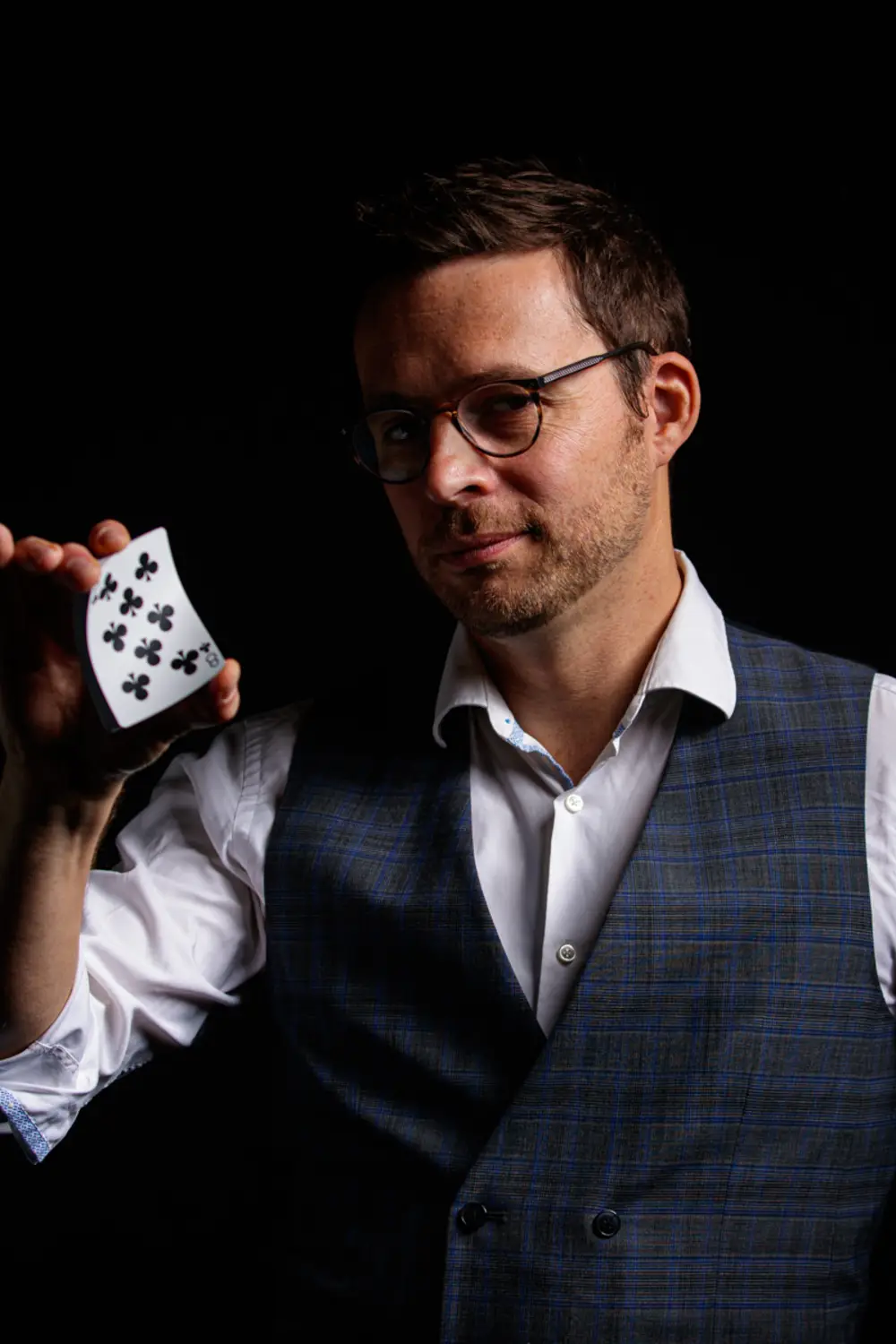
Hugo Marceau, professional magician and mentalist, who learnt magic the slow way
Hugo Marceau · magician, mentalist, AI magician

The path

Four stages, in the order that works

01 · The first month

One deck, one book, one trick

Buy a deck of ordinary playing cards and The Royal Road to Card Magic. Skip the chapters that look clever. Learn one self-working effect from the first pages, the kind that needs no sleight, and practise the handling until your hands are bored. Then say the words out loud while you do it. That is harder than the trick.

02 · Months two to six

Perform, then add a second branch

Show the trick to everyone: family, colleagues, the barista. Note what they say and where their eyes went. Only then open a second branch, coins with Bobo's Modern Coin Magic or a little mentalism, so the set has contrast. Three effects you own beat thirty you half know.

03 · The first year

A club, a mentor, a camera

Join a magic society. Show your set at its meetings, where the audience knows exactly where to look and will tell you. Film yourself: the camera is the most honest spectator you will ever have. Find one experienced performer whose work you admire and ask them to watch you. Most say yes.

04 · After that

Choose a voice, not a trick list

By now you know which branch you love. Build a ten-minute set around it, with a beginning, a strongest effect and an ending, and do that set a hundred times. A magician is someone with a repertoire they can do in their sleep and a character the audience remembers. The tricks are the least of it.

The books

What to read, and why books still beat videos

A video shows you a move; a book makes you build it. When you learn from a screen you copy the teacher's hands, their patter and their pacing. When you learn from a page you have to interpret the words, and the trick comes out as yours. That is why every professional I know keeps a shelf, and why the same titles come up when working magicians are asked where to start.

  • The Royal Road to Card Magic (Hugard and Braue). The card book. Each chapter teaches one sleight and immediately gives you tricks that use it, so you perform from the first week.
  • Card College (Roberto Giobbi). The modern, five-volume course that most serious card workers in Europe grew up on. Buy volume one after the Royal Road.
  • Modern Coin Magic (J. B. Bobo). Every coin vanish, change and production you will ever need, including the false transfer taught on the magic tricks for beginners page.
  • The Tarbell Course in Magic or Mark Wilson's Complete Course. The broad courses: cards, coins, rope, silks, stage. Read them to find out which branch is yours.
  • Strong Magic (Darwin Ortiz) and anything by Eugene Burger. No tricks. Only why an effect lands or dies, which is the subject you will spend the rest of your life on.

The clubs

Where to find people who will tell you the truth

Magic is the only art whose audience is forbidden to know how it is done, which makes feedback from ordinary spectators almost useless: they can say it was lovely, not that your left thumb flashed on the second phase. Other magicians can. That is what a society is for.

  • The Magic Circle, London, and its Young Magicians Club for under-eighteens; most British cities also have their own magic society, independent of it, with monthly meetings that usually admit a guest.
  • The Fédération Française de Magie, of which Hugo is a member, with regional clubs in Lyon, Paris, Geneva's neighbouring region and across France, and an annual congress where you see what the craft looks like at its best.
  • A good magic shop, in person. The owner will talk you out of half of what you want to buy, which is the best advice a beginner can get.
  • One mentor. Not a course, a person. Someone whose work you admire, who will watch your set twice a year and say what is wrong with it.

How to practise

Practice and rehearsal are two different things

Practice is learning the moves: the hands, alone, until the mechanics are automatic. Rehearsal is performing the whole trick, words included, to an empty chair as if a person were in it. Beginners do a great deal of the first and almost none of the second, then wonder why the trick that worked in the mirror fell apart at dinner. The mirror shows you your hands. The chair shows you your silences.

  1. Short and daily. Fifteen minutes with the deck while the kettle boils does more than a Sunday marathon, because the hands learn in sleep.
  2. Mechanics first, then words, then both. Never add the script until the hands no longer need your attention; otherwise you will stare at your fingers in front of people.
  3. Film it. Watch the recording with the sound off, then with the picture off. The first shows what flashed; the second shows whether the story makes sense.
  4. Perform early, perform small. One person, one trick, long before you feel ready. Nobody ever felt ready.
  5. Write down what happened. Where they looked, what they said, where they laughed. The notebook is where a repertoire is built.

What Hugo would do again, and what he would not

The mistakes that cost beginners a year

  • Buying tricks instead of learning moves. A trick from a shop gives you a thrill for an evening. A sleight from a book gives you a hundred tricks. Spend the first year's money on books and a club subscription.
  • Learning twelve things at once. The beginner's deck is full of half-finished effects. Finish one. The audience never knows how many you abandoned; they only see the one you show them.
  • Mistaking the method for the magic. The secret is not the trick. A perfect false transfer with nothing to say produces nothing; an average one carried by a story and a look produces mystery. Work on the words as hard as on the hands.
  • Hiding behind the camera. Social media magic is filmed from one angle for people who cannot talk back. The craft lives in front of three people who can.
  • Exposing. Never explain a trick to a spectator, however nicely they ask, and never repeat it for the same people. The first kills the mystery; the second tells them where to look.

If you are drawn to the mind rather than the hands

From magic to mentalism

Hugo started with cards and coins and moved, over the years, to mentalism, where the effect happens in the spectator's head rather than in their hands, and lately to an artificial intelligence he built to perform with him. The advice does not change. Mentalism looks simpler, because there is less to do with the fingers, and is harder, because there is nothing to hide behind: the performer is the trick. Six months of close-up magic in front of real people is the best preparation a future mentalist can have. When you are ready, the page on how to become a mentalist picks up where this one stops, and the page on magic tricks for beginners gives you the first effects to practise. For the craft of actually performing one, start with how to do a magic trick.

If you are planning an event

Learning is one pleasure. Watching a professional is another

Hugo performs close-up magic, mentalism and his AI act at corporate events, private dinners and weddings in France, Switzerland and wherever the brief takes him. If you would rather have the magic done for your guests than learn it, send the details of the evening and you will have a tailored proposal within one business day. Fees on request.

Prefer to talk first? +33 6 88 61 29 00, WhatsApp welcome, English and French. Formats and logistics on the page for event planners.

Reply within one business day, in English. No newsletter, no automated follow-up. Protected by reCAPTCHA: Google's privacy policy and terms apply.

Questions beginners ask

Learning magic, answered by a professional

Can anyone learn magic, or do you need special hands?

Anyone with patience can learn magic. Dexterity helps for sleight of hand, but whole branches of the art, mentalism and self-working card magic among them, need almost none. What every branch needs is practice, a few honest spectators and the willingness to perform badly a few times before performing well.

How long does it take to learn magic?

A first trick that genuinely fools friends takes a fortnight of daily practice. A short, reliable set of three or four effects takes a few months. Becoming a performer people pay to see takes years, because the hard part is not the method but holding a room. Fifteen minutes a day beats a long session once a week.

Which books should a beginner start with?

For cards, The Royal Road to Card Magic by Hugard and Braue, then Roberto Giobbi's Card College. For coins, J. B. Bobo's Modern Coin Magic. For a broad course across every branch, the Tarbell Course or Mark Wilson's Complete Course in Magic. For the thinking behind a performance, Darwin Ortiz's Strong Magic and Eugene Burger's writing on presentation.

Are YouTube tutorials a good way to learn magic?

They are a good way to see a move and a poor way to learn the craft. Many tutorials expose other people's work without permission and teach the method with nothing of the presentation. Use video to check your own hands against a good performer's, then go back to a book and a club where someone will tell you what is actually wrong.

Should I join a magic club?

Yes, as soon as you have one trick you can do without thinking. In the United Kingdom, The Magic Circle in London and the independent local societies around the country; in France, the Fédération Française de Magie, of which Hugo is a member, and its regional clubs. A club gives you what no video can: people who watch you perform and say where it failed.

Is it better to learn magic or mentalism first?

Learn a little magic first. Mentalism looks simpler because there is less to do with the hands, but it stands entirely on presentation and audience management, which are the skills magic teaches you by force. Six months of card and coin magic in front of real people is the best preparation a future mentalist can have.
Hugo Marceau, mentalist and AI magician · Magic tricks for beginners · How to do a magic trick · How to become a mentalist · What is mentalism · About Hugo · Corporate event entertainment · How card sharps work

CONTACT

LET'S DISCUSS YOUR EVENT